
Quick answer: What makes the United States a constitutional republic
Short definition
The United States is a constitutional republic, meaning the written U.S. Constitution is the supreme law that establishes the structure of government and sets limits on authority, while elected representatives carry out government functions under those rules Constitution (National Archives).
The United States is a constitutional republic: a system where the Constitution is the supreme written law that establishes institutions, limits power, and combines representative structures with democratic practices.
That label captures two linked ideas: a constitutional legal framework and republican institutions, such as representative legislatures and officials chosen by voters. It also recognizes that many day to day decisions are made through democratic processes like regular elections and majority rule, which work within the constitutional framework Is the United States a Democracy or a Republic? (Constitution Center).
Why the label matters for civic understanding
Calling the country a constitutional republic helps distinguish structural descriptions from policy judgments: the term explains how power is allocated and constrained, rather than predicting particular outcomes or policies Republic (Wex Legal Dictionary, Cornell).
For readers, the label points to primary sources, especially the Constitution, when they want to verify who has which powers and how those powers can be changed or limited over time Constitution (National Archives). See the constitutional rights hub for related site resources.
The constitutional foundation: what the Constitution establishes and why that matters
Supremacy clause, enumerated powers, and amendment rules
The Constitution sets out the basic institutions of national government, lists certain enumerated powers for Congress and the president, and includes the supremacy clause, which places the Constitution and valid federal law above conflicting state law Constitution (National Archives).
Those provisions create the legal reason the United States is described as a constitutional republic: the written instrument itself defines authorities and limits, rather than leaving structure solely to tradition or transient majorities United States - Government and Society (Encyclopaedia Britannica).
What the Constitution leaves to states or to amendment
The text and the amendment process also make clear that not all national powers are open ended; powers are enumerated for the federal government while other authorities remain with states or with the people unless the Constitution is amended, which is a deliberate, structured process Constitution (National Archives).
Because amendment procedures are specific and comparatively demanding, constitutional change tends to be incremental, and that durability is one reason the constitutional label is practically meaningful for governance and law United States - Government and Society (Encyclopaedia Britannica).
Join the Campaign for Updates and Ways to Get Involved
For readers wanting to check the primary provisions discussed here, consult the Constitution and official government summaries cited in this article.
How the Constitution limits and organizes federal power in practice
Mechanisms: statutes, executive action, and judicial review
In practice, the Constitution establishes a legal frame but day to day governance relies on statutes passed by Congress, executive actions by the president, and administrative rules; those acts must operate within constitutional constraints and can be reviewed for consistency with the Constitution Separation of Powers and Checks and Balances (U.S. Senate). The U.S. courts site has examples of separation of powers in action US Courts.
When conflicts arise between statutes or executive actions and constitutional text, courts may assess whether a law is consistent with constitutional requirements, which shapes how federal power is exercised over time Constitution (National Archives). See an essay on separation of powers at constitution.congress.gov.
Limits of federal authority and the role of states
The constitutional design leaves room for states to exercise authority in many policy areas; where the Constitution expressly grants power to the federal government, federal law governs, but in areas not enumerated to the national government, states typically retain primary responsibility Federalism in the United States (USA.gov).
That division means practical governance often involves negotiating the line between federal statutes and state authority, and courts frequently become the forum for resolving those disputes when legal conflict arises United States - Government and Society (Encyclopaedia Britannica).

Federalism explained: division of powers between national and state governments
What is reserved to states
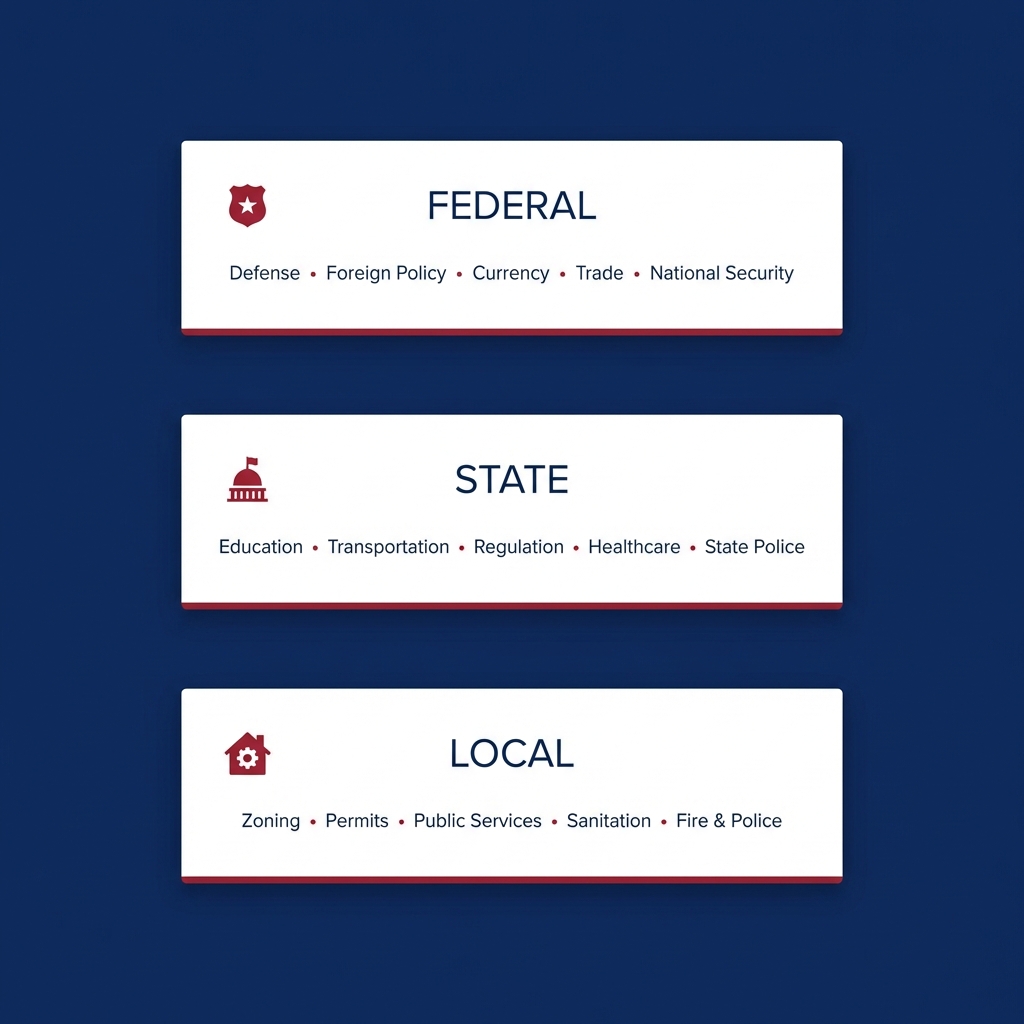
Federalism is a defining feature of the constitutional system: certain powers are allocated to the national government while others are left to states, local governments, or the people, which shapes who is responsible for issues such as education, local policing, and many aspects of public health Federalism in the United States (USA.gov).
Those reserved authorities mean everyday policy choices often fall to state or local officials, and understanding which level of government handles an issue helps voters know where to direct inquiries or hold officials accountable United States - Government and Society (Encyclopaedia Britannica).
How federal and state powers interact in practice
Interactions between federal and state powers can take the form of cooperative programs, federal grants with conditions, regulatory preemption, or legal disputes decided in courts; these mechanisms reflect the constitutional balance where both national priorities and state discretion matter Federalism in the United States (USA.gov).
For example, taxation demonstrates federalism at work: the national government raises federal revenues while states levy their own taxes and decide how to allocate revenues for state priorities, illustrating how layered authority operates within the constitutional framework United States - Government and Society (Encyclopaedia Britannica).
Separation of powers: how the legislative, executive, and judicial branches check each other
Legislative powers and limits
Congress is the national legislature that writes statutes, controls appropriations, and holds oversight powers, but its authority is shaped by constitutional limits and by the need to work with the executive branch on implementation Separation of Powers and Checks and Balances (U.S. Senate). Legal groups also offer primers on separation of powers American Bar Association.
Those constitutional limits include enumerated powers and procedural rules, so legislative action is one part of a system that distributes powers rather than concentrating them in a single body Constitution (National Archives).
Executive powers, veto, and enforcement
The president enforces federal law and possesses specific constitutional authorities, including acting as commander in chief and exercising veto power over legislation, which creates a direct check on Congress while leaving space for Congress to respond through overrides and legislation Constitution (National Archives).
Because enforcement and interpretation depend on both executive choices and judicial review, presidential actions are effective within the limits set by law and the Constitution, rather than being unilateral sources of lasting legal change Separation of Powers and Checks and Balances (U.S. Senate).
Judicial review and its effects
Courts, and ultimately the Supreme Court, review whether statutes and executive actions conform to constitutional text and precedent; judicial review is a central mechanism that interprets constitutional meaning and can limit or uphold governmental actions Separation of Powers and Checks and Balances (U.S. Senate).
The availability of judicial review means constitutional rules are applied in concrete disputes, producing case law that shapes how the separation of powers functions in practice over time Constitution (National Archives).
Quick guide to explore the functions of each branch
Use this list to compare responsibilities
Checks and balances in practice: everyday examples of constitutional processes
How a bill becomes law and the veto override
A bill generally begins in Congress, is passed by both chambers, and is sent to the president for signature or veto; if the president vetoes a bill, Congress can override with a sufficient majority, which illustrates a formal check between branches Constitution (National Archives).
That sequence shows how lawmaking combines representative decision making in Congress with executive review, and how constitutional procedures create backstop mechanisms for resolving disagreements between branches Separation of Powers and Checks and Balances (U.S. Senate).
Judicial review of statutes
When courts review statutes, they assess consistency with constitutional text and precedent; if a statute conflicts with the Constitution as interpreted by courts, judges may invalidate it or narrow its application, shaping policy through legal interpretation rather than through direct policy making Separation of Powers and Checks and Balances (U.S. Senate).
Judicial decisions can therefore change how statutes operate, while leaving political actors to adjust laws or pursue constitutional amendments where appropriate, which underlines the dynamic between courts and elected officials Constitution (National Archives).
State-federal disputes in courts
Disputes between states and the federal government often end up in federal courts, where judges interpret constitutional allocation of powers and decide whether federal actions preempt state law or whether states retain authority in specific areas United States - Government and Society (Encyclopaedia Britannica).
These cases show federalism and separation of powers working together: courts interpret constitutional limits, and those interpretations affect how states and the national government coordinate or compete on policy matters Federalism in the United States (USA.gov).
Republican and democratic elements: how representation and popular rule coexist
Representative institutions and indirect mechanisms
The United States contains republican elements such as representative legislatures and constitutional limits that shape how officials are selected and what they may do in office; those features reflect a republican tradition of rule through elected representatives under law Republic (Wex Legal Dictionary, Cornell).

Representative institutions mean voters choose lawmakers who make decisions on their behalf, and constitutional rules aim to prevent short term majorities from overriding fundamental rights or structural constraints without due process Is the United States a Democracy or a Republic? (Constitution Center).
Democratic practices: elections, participation, and majority decision-making
At the same time, democratic practices such as regular elections, public participation, and majority rule in many settings are essential to how policies are made and officials are held accountable, which is why many observers describe the United States as having both republican and democratic features Is the United States a Democracy or a Republic? (Constitution Center).
Scholars and practitioners continue to debate how institutional design and legal interpretation influence democratic outcomes, but the coexistence of constitutional limits and popular participation is a core reason the combined label is useful for civic understanding Republic (Wex Legal Dictionary, Cornell).
Concrete examples and case studies: lawmaking, vetoes, and court decisions
A sample lawmaking timeline
A typical timeline starts with drafting and committee work in Congress, proceeds to votes in each chamber, goes to the president for signature or veto, and may include court review later if the law's constitutionality is challenged, illustrating the sequence of legislative, executive, and judicial roles Constitution (National Archives).
That timeline helps readers see how representative choices in Congress can be checked by executive action and judicial interpretation, producing layered review rather than single actor dominance Separation of Powers and Checks and Balances (U.S. Senate).
A sample judicial review case and its implications
When a court finds a statute inconsistent with constitutional text or precedent, it may strike down the statute or limit its scope; such outcomes demonstrate how constitutional interpretation can redirect policy by removing legal authority for particular measures Separation of Powers and Checks and Balances (U.S. Senate).
These cases typically prompt political responses, such as legislative revision or efforts to pursue constitutional amendment, which shows the system's built in routes for change when judicial interpretation affects policy Constitution (National Archives).
A state-federal policy dispute example
Disputes where state policies conflict with federal statutes or constitutional interpretation are resolved through litigation and can clarify whether federal law preempts state regulation, illustrating federalism in action and the courts role in mediating intergovernmental tension United States - Government and Society (Encyclopaedia Britannica).
These interactions affect practical outcomes for residents, because court decisions determine whether a state policy stands or whether federal law overrides local choices in specific policy areas Federalism in the United States (USA.gov).
How to evaluate claims about the United States being a constitutional republic: decision criteria for readers
Source types to trust: primary texts, legal summaries, government pages
When assessing claims about government type, prioritize the Constitution itself and official government explanations for foundational questions, and use reputable legal dictionaries and encyclopedias for definitions and context Constitution (National Archives).
Primary sources and government pages provide the most direct evidence about institutional structure, while vetted secondary sources help explain how those structures operate in practice United States - Government and Society (Encyclopaedia Britannica).
Questions to ask of a claim about government structure
Ask whether the claim references the Constitution, whether it cites primary or reputable secondary sources, and whether it describes structure or prescriptive outcomes; these questions help separate descriptive statements from partisan slogans or predictions Republic (Wex Legal Dictionary, Cornell).
As a quick checklist, verify: is the claim grounded in constitutional text? does it reflect accepted legal definitions? and is it presented as description rather than advocacy? Reliable answers often point back to the primary texts and authoritative educational resources Constitution (National Archives). For questions, see the contact page.
Common misunderstandings and pitfalls to avoid when talking about the U.S. system
Confusing the constitutional label with policy outcomes
One common error is using the phrase constitutional republic as if it guarantees particular policy outcomes; the term is descriptive of structure and legal rules, not a promise about what policies will occur in practice Is the United States a Democracy or a Republic? (Constitution Center).
To avoid this mistake, check whether a claim is about institutional design or about expected policy effects, and prefer primary sources for structural assertions Constitution (National Archives).
Using 'republic' and 'democracy' as mutually exclusive
Another pitfall is treating 'republic' and 'democracy' as mutually exclusive terms; in U.S. practice republican institutions coexist with democratic practices like elections and majority decision-making in many contexts Is the United States a Democracy or a Republic? (Constitution Center).
Clearer discussion recognizes overlap and difference: 'republic' refers to constitutional structures and representative mechanisms, while 'democracy' highlights popular participation and decision procedures, and both matter for a full description Republic (Wex Legal Dictionary, Cornell).
Practical scenarios: how the constitutional republic matters for voters and local policy
What voters can expect from federal vs state officials
For ordinary voters, the constitutional republic means some issues-defense, currency, interstate commerce-are typically handled at the federal level, while many local services and regulations fall to states or localities, which affects where citizens seek redress or engage with officials Federalism in the United States (USA.gov).
Knowing which level of government oversees an issue helps voters decide where to contact officials, whether to follow federal court decisions on applicability, and how to focus civic participation for local versus national concerns United States - Government and Society (Encyclopaedia Britannica).
How constitutional limits shape local outcomes
Constitutional limits create boundaries on what state and federal actors can do, and those limits shape local policy choices by defining the legal authority available to implement programs or regulate behavior within a jurisdiction Constitution (National Archives).
When disputes arise about whether a policy is permitted under federal law or the Constitution, court decisions can determine whether local initiatives survive or must be modified, demonstrating the practical reach of constitutional rules Federalism in the United States (USA.gov).
Quick guide: primary sources and trustworthy references to learn more
Key primary documents to read
Start with the Constitution itself and the National Archives presentation of the Charters of Freedom for primary text and historical context; those texts answer foundational questions about institutional design and the supremacy of the Constitution Constitution (National Archives).

For legal definitions and helpful explanations, consult reliable resources such as the Cornell Law School Wex legal dictionary and established encyclopedias for accessible summaries and context Republic (Wex Legal Dictionary, Cornell).
Reliable educational and government resources
Government pages on federalism and educational resources from the U.S. Senate provide clear discussions of separation of powers and practical processes, and are useful starting points for readers who want authoritative overviews Separation of Powers and Checks and Balances (U.S. Senate).
Encyclopedic entries and USA.gov overviews complement primary texts by describing how institutions operate in practice and where common lines of authority typically fall United States - Government and Society (Encyclopaedia Britannica). More updates are available on the news page.
Conclusion: why 'constitutional republic' is a useful, but not exhaustive, label
Summary of what the term explains
Describing the United States as a constitutional republic highlights that the Constitution is the supreme written law and that representative institutions operate under constitutional constraints, which clarifies structural features of governance Constitution (National Archives).
Open questions and ongoing debates
At the same time, democratic practices, judicial interpretation, and administrative governance shape how the system functions in practice, and scholars continue to debate how those elements affect outcomes and accountability Is the United States a Democracy or a Republic? (Constitution Center).
No. The United States is commonly described as a constitutional republic with democratic features: republican elements refer to constitutional limits and representative institutions, while democratic features include regular elections and popular participation.
The U.S. Constitution is the primary written source that establishes the government structure and legal limits; official repositories such as the National Archives provide the authoritative text.
Courts review laws for consistency with the Constitution through judicial processes; authoritative summaries from government educational pages and legal reference works explain how judicial review works.
References
- https://www.archives.gov/founding-docs/constitution
- https://constitutioncenter.org/blog/is-the-united-states-a-democracy-or-a-republic
- https://www.law.cornell.edu/wex/republic
- https://www.britannica.com/place/United-States/Government-and-society
- https://www.senate.gov/about/powers-procedures/separation-of-powers.htm
- https://www.usa.gov/federalism
- https://michaelcarbonara.com/contact/
- https://michaelcarbonara.com/constitutional-rights/
- https://constitution.congress.gov/browse/essay/intro.7-2/ALDE_00000031/
- https://www.uscourts.gov/about-federal-courts/educational-resources/educational-activities/first-amendment-activities/us-v-alvarez/separation-powers-action-us-v-alvarez
- https://www.americanbar.org/groups/crsj/about/initiatives/civil-rights-civics-institute/constitution-separation-powers/
- https://michaelcarbonara.com/news/